Arriving
Narita or Haneda to Tokyo with Kids: Which Transfer to Take
By the kyounoko team — Tokyo parents who have done every one of these transfers with a small child.
Last verified: August 2026 · written in Tokyo
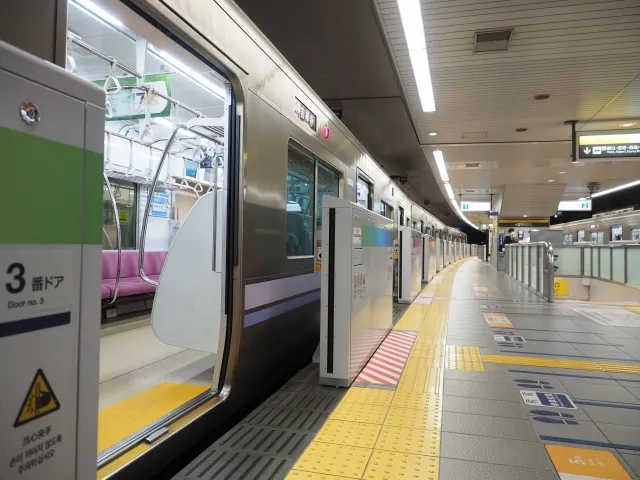
From Haneda, take the Keikyu line — Shinagawa in about fifteen minutes — or a taxi if you are wrecked. From Narita, take the Airport Limousine Bus if it stops at your hotel, because it is the only option with no stairs, no transfers and someone else handling the suitcases; take the Skyliner or Narita Express instead if speed matters and your hotel is near their terminus. Children under six travel free on the trains.
The transfer is the hardest ninety minutes of a family trip to Japan. Everyone is exhausted, nobody has slept properly, and you are carrying more than you will carry on any other day. The right choice is not the fastest one — it is the one with the fewest times you have to pick everything up again.
We give rounded journey times and no prices on purpose: fares and timetables change, and a guide that quotes them goes stale silently. Check the current fare and schedule with the operator when you book — what does not change is which option suits which family, and that is what this page is for.
From Narita
Narita is roughly sixty kilometres out of the city, so there is no quick option — only different trade-offs between speed, seats and how many times you change.
Airport Limousine Bus
About 1.5–2 hours, traffic dependent
Major hotels and stations across central Tokyo
The only option with no stairs, no transfers and no carrying. Staff load your suitcases into the hold, you get a reserved seat, and it often stops at your hotel door. With a sleeping baby and a luggage trolley this is usually the right answer even though it is the slowest.
The catch. Traffic. If you land in the evening rush it can run well over two hours, and there is no getting off early.
Keisei Skyliner
About 40 minutes to Nippori
Nippori and Keisei Ueno
The fastest way out of Narita, with reserved seats and proper luggage racks. Excellent if you are staying in Ueno or anywhere on the north-east side, because you arrive almost at your hotel.
The catch. You still have to cross Tokyo from Ueno or Nippori if your hotel is elsewhere — that transfer with luggage and a toddler is the part people underestimate.
Narita Express (N’EX)
About an hour to Tokyo Station
Tokyo Station, Shinagawa, Shinjuku, Ikebukuro, Yokohama
Reserved seats, generous luggage space and it goes directly to more of the places families actually stay. If your hotel is near Tokyo Station or Shinjuku, this removes the transfer entirely.
The catch. Slower than the Skyliner, and the through-carriages split en route — check which car you need before boarding, which is harder than it sounds with children in tow.
Keisei Access / main line
About an hour to an hour and twenty
Asakusa line stations, including Asakusa and Nihombashi
The budget option, and it through-runs onto the Asakusa subway line, so if you are staying in Asakusa you can arrive without changing trains.
The catch. No reserved seats. After a long-haul flight, standing with a toddler and suitcases is a genuinely miserable start.
From Haneda
Haneda is inside Tokyo, which changes everything. Every option here is short enough that comfort matters less than it does from Narita — if you have the choice when booking flights, this airport is worth paying a premium for when travelling with small children.
Keikyu line
About 15 minutes to Shinagawa
Shinagawa, then through onto the Asakusa line
Fast, frequent and cheap, and the through-service means Asakusa and Nihombashi are reachable without changing. From Haneda the journey is short enough that the lack of reserved seats barely matters.
The catch. It is a normal commuter train. Avoid it at rush hour with a stroller if you possibly can.
Tokyo Monorail
Under 20 minutes
Hamamatsucho, for the Yamanote line
Elevated the whole way with big windows over the bay — genuinely a hit with small children, and a nice way to start the trip.
The catch. You have to change at Hamamatsucho, and that station is less stroller-friendly than Shinagawa.
Taxi
Around 30–45 minutes to central Tokyo
Anywhere, door to door
From Haneda a taxi is expensive but not absurd, and door-to-door with no stairs is worth a lot at the end of a long flight. Taxis are legally exempt from Japan’s child-seat rule, so you will not be turned away for travelling without one.
The catch. No child seats are carried. From Narita a taxi is expensive enough that most families should not consider it.
Do children pay?
On Japanese trains the rule is the same across JR and the private railways:
- Under 6: free, up to two children per fare-paying passenger.
- 6 to 11: half the adult fare.
- 12 and over: adult fare.
The exception that catches people out is reserved seating. On the Skyliner and the Narita Express, an under-six riding free is riding on your lap. If you want them in their own reserved seat — and on an hour-long journey after a long-haul flight, you probably do — you buy them a child ticket. Budget for that when you book. Buses generally work the same way: free on a lap, a child fare for their own seat, so confirm when booking.
Once you are in the city, the same rules apply on the subway. Our guide to Tokyo trains with a stroller covers the elevator hunt, the wide ticket gate and the hours to avoid.
The stroller, and the airport itself
You can use your own stroller right through the terminal to the gate on departure, and most airlines return it at the aircraft door or at baggage reclaim on arrival — confirm which with your airline, because it changes how you plan the walk to the train. Once you are landside, you do not need to fold it for any of the trains above, though on reserved services it is usually easier to fold it into the luggage rack and carry the baby to the seat.
Both Narita and Haneda have baby rooms with nursing and changing facilities in every terminal. Use them before you start the transfer, not during it — a fed, changed baby is the difference between a ninety-minute bus ride being restful and being the worst part of the holiday.
Choose by where you are staying
The transfer question is really a hotel question. If you have not booked yet, decide the neighbourhood first and the transfer follows from it — Ueno pairs with the Skyliner, Tokyo Station and Shinjuku with the Narita Express, Asakusa with the through-running Keisei and Asakusa lines, and Shinagawa with Haneda and the Keikyu line.
Where to stay in Tokyo with kids ranks the areas on step-free access and family facilities, and notes the airport connection for each one.
Common questions
What is the easiest way from Narita to Tokyo with kids?
The Airport Limousine Bus, if your hotel is one of its stops. It is the slowest option at roughly one and a half to two hours, but staff load your luggage, you get reserved seats, there are no stairs and no transfers, and it frequently stops at the hotel door. With small children the number of times you have to pick everything up matters more than the journey time.
Is Haneda or Narita better with children?
Haneda, clearly, and it is worth paying something for. Haneda is inside Tokyo: the Keikyu line reaches Shinagawa in about fifteen minutes and a taxi is affordable. Narita is a long way out, so every option costs at least forty minutes and most cost an hour or more. If you can choose your flights, choose Haneda.
Do children pay train fare in Japan?
Children under six travel free on Japanese trains, up to two free children per fare-paying passenger. Children aged six to eleven — elementary-school age — pay half the adult fare, and from twelve the adult fare applies. The important exception on airport trains is reserved seating: if an under-six occupies their own reserved seat rather than sitting on your lap, you must buy them a child ticket.
Can I take a stroller on the Narita Express or Skyliner?
Yes. You do not need to fold a stroller on Japanese trains, and both services have luggage racks at the end of the carriage where a folded stroller fits easily. On reserved services it is usually easier to fold it and stow it, then carry the baby to the seat.
Are there nursing rooms at Narita and Haneda airports?
Yes — both airports have baby rooms with nursing and changing facilities in each terminal, on both the landside and airside. Look for the baby-symbol signage or ask at an information desk; staff at both airports handle this question constantly. Feed and change before you start the transfer rather than during it.
Should we book airport transfer tickets in advance with kids?
For the reserved services — Skyliner, Narita Express and the limousine bus — yes. Booking ahead means you are not standing at a ticket machine with a jet-lagged toddler while other passengers queue behind you, and it guarantees your family sits together. For the Keikyu line from Haneda there is no need; just tap through with an IC card.
Book the transfer before you fly
Some links below are affiliate links. If you book through them we may earn a small commission, at no extra cost to you. We only list things we would actually use — see our disclosure.
Tickets & tours (Klook)
Skip-the-line tickets and family experiences — teamLab, theme parks, day trips and more.
Browse experiences →Japan eSIM (Airalo)
Get online the moment you land — an eSIM installs before you fly, no pocket-wifi pickup counter.
Get a Japan eSIM →Family hotels (Booking.com)
Filter for family rooms, cribs and step-free access near the station.
Find family hotels →The transfer is the easy leg — the flight is the long one.
Our printable Japan Flight Kit for kids keeps the plane hours occupied, so the train into Tokyo is the calm part of the day.
See the Flight Kit on Etsy →