Getting around · Trains
Tokyo Trains with a Stroller: The Rules Nobody Explains
By the kyounoko team — Tokyo parents who ride these lines with our own prams every week.
Last verified: August 2026 · written in Tokyo
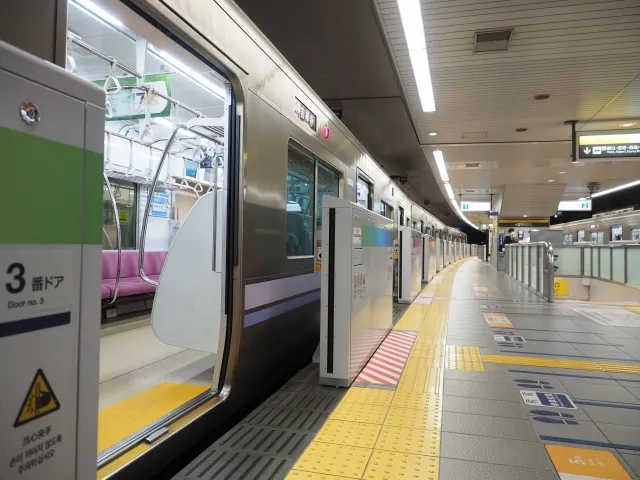
Strollers ride open, free, on every train in Tokyo — you never have to fold one, and many cars have a marked stroller space. What actually decides whether the day is easy is two things: whether you can find the elevator (every station has one, almost always hidden at one specific exit), and whether you are on the train between 10am and 4pm, when Tokyo’s famous crowds simply are not there.
The rule: open stroller, marked space, brake on
Japan settled this officially years ago: since 2014 the national guidance — posted as a blue stroller symbol in stations and train cars — is that strollers may stay open on board. Look for the cars marked with a wheelchair/stroller symbol on the platform floor or door; inside is a free space with no seats where the pram stands flat against the wall. Put the wheel brake on and hold the handle; Tokyo trains brake smoothly but firmly. Nobody will ask you to fold, and with a sleeping baby nobody expects you to.
The elevator hunt (the real skill)
Every station has one — at one exit
Tokyo stations are legally barrier-free, but the elevator is rarely at the exit you happen to be near. Before you tap in, check the station map by the gates for the エレベーター (elevator) mark, or ask staff: “elevator?” works everywhere.
Follow the wheelchair signs
The step-free route through any station is signed with the wheelchair symbol. When in doubt, follow it — it always ends at an elevator, even when that means walking the long way round the platform.
Old lines are the hard ones
The oldest subway lines (the Ginza line is from 1927) squeezed elevators in decades later, so the step-free route can be genuinely roundabout. Newer lines were built with elevators at every exit. Our station guides note the easiest exit for each station we cover.
The wide ticket gate
Every gate line has one wide lane, usually at the end nearest the staff window — the stroller fits through without the fold-and-shuffle. Tap your IC card as normal.
Timing beats everything
Tokyo’s crowds are a schedule, not a constant. Weekday rush runs roughly 7:30–9:30am and 5:30–8pm; inside those windows the busiest lines are shoulder-to-shoulder and genuinely not for prams. Outside them the same trains have open floor and seats. Plan the family day 10am–4pm — which fits toddler rhythm anyway — and Tokyo’s scariest-sounding problem disappears. Weekends are gentler all day, with crowds at destinations rather than on the trains.
Shinkansen with a stroller
Bullet trains are the easy part of the trip. Strollers are exempt from the oversized-baggage reservation rule, but do this anyway: when booking reserved seats, choose the last row of the car and reserve the oversized-baggage space behind it — it costs nothing, and the folded stroller stands there instead of living in the vestibule. Elevators serve every Shinkansen platform, and if you need to nurse mid-journey, ask the conductor about the multipurpose room. Rules can shift, so glance at the current baggage policy when you book.
Buses and taxis, briefly
- City buses take open strollers in a marked space mid-bus; board at the middle door where there is one, and use the strap or bar to steady the pram.
- Taxis are legally exempt from Japan’s child-seat law — children ride held or belted, and the folded stroller goes in the boot. Ride-hailing apps (GO is the big one) work in English.
- Coin lockers will not take a stroller, so plan on it staying with you all day — one more reason a light, foldable travel stroller beats the full-size rig in Tokyo.
Common questions
Are strollers allowed on Tokyo trains and subways?
Yes — on every line, at no charge, and you do not have to fold the stroller. Japan’s official guidance since 2014 is that strollers may stay open on trains; many cars have a marked free space with a stroller symbol. The practical challenges are elevators and rush hour, not permission.
Do I have to fold my stroller on the train?
No. Keep it open, put the brake on, and stand with it in the free space by the doors of the cars marked with a wheelchair/stroller symbol. Folding is only the considerate move if you board a genuinely packed car — which, with the timing below, you should not have to do.
Can you take a stroller on the Shinkansen?
Yes. Strollers are exempt from the Shinkansen’s oversized-baggage reservation rule, but the comfortable move is still to reserve the last-row seats with the oversized-baggage space behind them (free to reserve) so the stroller stands folded behind you instead of blocking the deck. Policies can change — check when you book.
What time should I avoid Tokyo trains with a stroller?
Weekday rush runs roughly 7:30–9:30am and 5:30–8pm, and central lines in those windows are genuinely no place for a pram. Between 10am and 4pm, and most of the weekend, Tokyo trains are calm and stroller-friendly.
Do taxis in Japan have car seats?
Taxis are legally exempt from Japan’s child-seat requirement, so children may ride held or belted without one, and most taxis carry no seat. The stroller goes folded in the boot. If that trade-off bothers you, trains genuinely are the easier and cheaper option in Tokyo.
Transit policies are stable in Japan but not immortal — treat the specifics here as how it worked when we last verified, and check current rules for the Shinkansen baggage reservation when you book.
Sort the transport before you land
Some links below are affiliate links. If you book through them we may earn a small commission, at no extra cost to you. We only list things we would actually use — see our disclosure.