Under 18 months
Tokyo with a Baby: Feeding, Sleeping and Getting Around
By the kyounoko team — a Tokyo parenting team who map baby facilities across the city for a living.
Last verified: August 2026 · researched in person in Tokyo
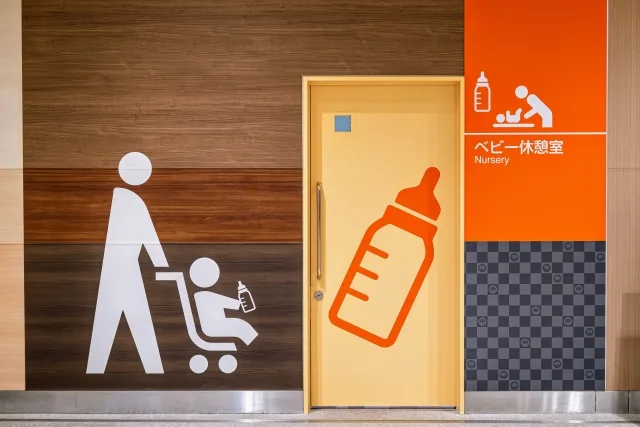
Tokyo is unusually easy with a baby: free baby rooms with private nursing booths and hot water for formula sit inside most department stores and station buildings, strollers ride open on trains without folding, and diapers and formula are sold on nearly every corner — so you can pack light. The two things worth sorting before you fly are where the baby will sleep and whether you are bringing a carrier as well as a stroller.
Across 26 Tokyo neighbourhoods we have checked 78 nursing-room locations and mapped 319 restaurant listings — 279 of them (about 87%) let you bring your own baby food, and 167 (about 52%) have a changing table in store.
The four things to sort out
Feeding
Tokyo solves this better than almost anywhere. Baby rooms inside department stores, malls and station buildings are free, clean and nearly all have a hot-water dispenser meant for making up formula, plus a private nursing booth. Nursing in the open is uncommon here — not disapproved of, just unnecessary, because the booths are everywhere.
Where the nursing rooms are →Sleeping
A cot is a request, not a facility: Japanese hotels hold two or three and allocate them first come, so ask when you book rather than at check-in. The better-kept secret is the Japanese-style room — futons on tatami put the whole family on a padded floor with nothing to roll off, which removes the crib question entirely.
Tokyo hotels with cribs →Getting around
You never have to fold a stroller on a Tokyo train, and cars have marked spaces for them. The catch is the elevator: it is usually at one specific station exit rather than all of them. Most families here carry both — stroller for distance and naps, carrier for crowded market streets and older stations.
Trains with a stroller →Diapers and supplies
Pack far less than you think. Every drugstore and convenience store sells diapers, wipes, formula and pouch baby food, and Japanese tap water is soft, so it is fine for making up formula. The luggage is better spent on things you cannot buy here — your own brand of anything your baby is fussy about.
Formula, diapers & baby food →Where a baby is easiest to feed and change
These are the neighbourhoods where the highest share of the restaurants we have mapped have a changing table in store. They are all areas built around big station buildings and department stores, which is exactly where Japan puts its baby facilities.
We rank by share rather than by raw count on purpose: counting changing tables would mostly measure how many restaurants we happen to have mapped in each area, which says more about our database than about the neighbourhood. Areas with fewer than ten mapped restaurants are left out because a percentage of a small number is noise.
How a baby trip differs from a toddler trip
If you are choosing dates and wondering whether to come now or wait, this is the honest comparison. Under-ones are the easiest age to travel with in Japan; the difficulty starts once they can walk.
- A baby sleeps wherever you are, so the schedule bends. A toddler needs the day built around one nap.
- A baby eats what you brought or what you can warm. A toddler needs a restaurant that will actually feed them.
- A baby stays in the stroller. A toddler wants out of it, in the middle of a crossing.
- With a baby the hard part is logistics — feeding, changing, sleeping. With a toddler it is pacing.
Travelling with a one-to-four-year-old instead? Our Tokyo with toddlers guide covers the pacing side — naps, meltdowns and what they will actually eat.
Before you fly
Two things are worth deciding at home. Where you base yourself matters more with a baby than with older kids, because you will go back to the room mid-day more often than you expect — a short walk from the station is worth more than a nicer view. And jet lag hits babies too, though usually less brutally than toddlers.
- Where to stay in Tokyo with kids — the areas ranked on step-free access and facilities, not nightlife.
- Jet lag with a small child in Japan — the first-48-hours plan.
- Our free packing list — written around the fact that you can buy most of it here.
Common questions
Is Tokyo easy to visit with a baby?
Yes — it is one of the easiest cities in the world for the under-ones. Free baby rooms with private nursing booths and hot water for formula sit inside most department stores and station buildings, strollers ride open on trains, and diapers, wipes and formula are sold on nearly every corner. Across the 26 Tokyo neighbourhoods we have mapped we have checked 78 nursing-room locations.
Where can I warm a bottle or get hot water in Tokyo?
In any department-store or mall baby room — nearly all have a hot-water dispenser provided specifically for making up formula. Convenience stores and cafés will also usually give you hot water if you ask. Japanese tap water is soft and safe, so it is suitable for formula.
Can I bring my own baby food into restaurants in Japan?
Generally yes, and it is completely normal at chain restaurants — staff will often warm it or bring hot water. 279 of the 319 restaurant listings in our Tokyo database accept it, which is about 87%. It is less appropriate at small owner-run restaurants and counter sushi.
Do I need to bring a stroller or a baby carrier to Tokyo?
Bring both if you can. Strollers are welcome open on trains and are the better option for distance and for letting a baby sleep, but a carrier wins in crowded market streets, at older stations where the elevator is a long detour, and on temple grounds with gravel and steps.
Should I pack diapers and formula for Japan?
Only enough for the journey and the first day. Japanese drugstores and convenience stores stock diapers, wipes, formula and baby food everywhere, often more cheaply than at home. The exception is anything your baby is particular about — bring your own if a brand switch would cause trouble.
Which restaurants in Tokyo have baby changing tables?
Among the chains we track, these reliably do: Bamiyan, Denny’s Japan, Gusto, Gyu-Kaku, Hama Sushi, Jonathan’s, Komeda’s Coffee, Kura Sushi, McDonald’s, Ootoya, Royal Host, Saizeriya, Sushiro, Uobei. Across our whole database that is 167 of 319 listings, roughly 52%. Outside those, use the baby room in the nearest department store or station building — it will be better equipped anyway.
Book the trip around it
Some links below are affiliate links. If you book through them we may earn a small commission, at no extra cost to you. We only list things we would actually use — see our disclosure.
Family hotels (Booking.com)
Filter for family rooms, cribs and step-free access near the station.
Find family hotels →Japan eSIM (Airalo)
Get online the moment you land — an eSIM installs before you fly, no pocket-wifi pickup counter.
Get a Japan eSIM →Tickets & tours (Klook)
Skip-the-line tickets and family experiences — teamLab, theme parks, day trips and more.
Browse experiences →Planning the days as well as the logistics?
Our printable Tokyo plan marks the nearest baby room and an easy meal on every route, so the logistics are solved before you leave the hotel.
See the itinerary on Etsy →