Planning · Where baby sleeps
Tokyo Hotels with Cribs: Do They Have Them, and How to Get One
By the kyounoko team — Tokyo-based parents who book these rooms for our own families.
Last verified: August 2026 · written in Tokyo
Most mid-range and larger Tokyo hotels have cribs, but a crib is not something you book — it is shared stock of two or three cots for the whole hotel, released first-come-first-served to whoever asks. So the rule is: book the room, then email the hotel immediately and request a cot in writing. And before you do, check the two things that catch families out — whether the room is physically big enough for a cot, and whether the hotel already lets your child sleep in your bed for free.
The word you need: ベビーベッド
In Japanese a hotel crib is a “baby bed” — ベビーベッド (bebī beddo). This matters because Japanese hotel websites, and staff using translation apps, will not always recognise “crib” or “cot”. If you use the Japanese word you get a straight answer instead of a confused one.
Two more terms are worth knowing, because they decide whether you need a cot at all: 添い寝 (soine) means a child sleeping in the parents’ bed, and 和室 (washitsu) is a Japanese-style room where everyone sleeps on futons on the floor. Both are covered below.
Why cribs run out (and what that means for you)
They are shared stock, not room equipment
A Tokyo hotel might own two or three cots for hundreds of rooms. They are lent out in order of request, so a family who emailed a month ago has it and you do not. Nothing on the booking site will tell you this.
The room may be too small to fit one
Standard Tokyo business-hotel rooms are often only 12–18㎡, with barely a walkway between the bed and the wall. Even when the hotel has a cot free, it may not physically fit. Look at the room size in ㎡ on the listing, and choose a twin, triple or family room if you need floor space.
They are sized for babies, not toddlers
Hotel cots are commonly limited to around 12–24 months, sometimes by weight. If your child climbs, expect the hotel to say no — and take the futon option instead.
A booking-site request is not a confirmation
Ticking a box or leaving a note in “special requests” is a wish, not a reservation. Only a direct reply from the hotel saying the cot is held for your dates counts.
Copy this email to the hotel
Send this the day you book. Japanese hotels answer email reliably, and staff who are not confident in English will still understand the Japanese half instantly. Fill in the bracketed parts.
In Japanese
〔宿泊日〕に予約している〔氏名〕と申します。予約番号は〔番号〕です。 ベビーベッドを1台お借りできますでしょうか。子どもは〔月齢〕か月です。 ご用意が難しい場合、添い寝は可能でしょうか。また、料金がかかる場合は金額を教えてください。 よろしくお願いいたします。
In English
I have a reservation for [dates] under [name], booking number [number]. Could we please borrow one baby bed (crib)? Our child is [x] months old. If a crib is not available, is co-sleeping in our bed allowed? Please also let us know any charge. Thank you very much.
Asking both questions in one email is the trick: if the cot is gone you find out straight away whether you can share a bed instead, rather than discovering it at midnight on arrival day.
The free option most visitors never hear about
Japan has a widespread hotel practice called 添い寝無料 — free co-sleeping — where a young child sharing the parents’ bed is not charged at all and does not count as an occupant. The age limit is set by each hotel, so you will see anything from under-6 to under-12 in the child policy, and it usually means no extra bed, no breakfast and no amenities for that child.
For most families with a baby or a small toddler this is simply the easier answer than hunting a cot. The one thing to check is bed width: a Japanese room described as “double” frequently has a single 140cm bed, which is tight for two adults and a wriggling toddler. Book a twin room and push the beds together, or a triple, and the problem disappears.
The best answer of all: a futon on tatami
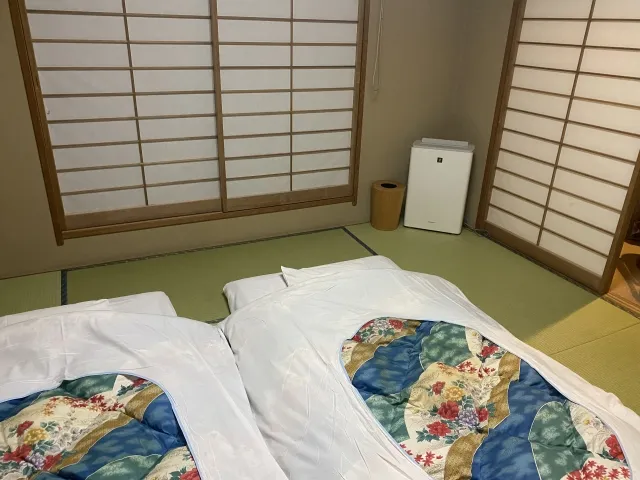
If your child is past the cot stage, book a Japanese-style room (和室) or a Japanese-Western room (和洋室) in a ryokan or a hotel that offers them. Everyone sleeps on futons laid directly on the tatami floor, which solves the problems a hotel room creates:
- Nothing to fall off. A toddler on a floor futon cannot roll out of a bed, so you can stop building pillow walls and actually sleep.
- Room to spread out. A washitsu is open floor space rather than two beds wedged in — the futons come out at bedtime and go away in the morning.
- Bedding is added per person, so a family of four fits in one room without needing a second one.
- Crawling babies get a clean, warm, slightly springy floor instead of a narrow strip of carpet.
Two things to know before booking one: traditional ryokan often price per person including meals, so check how children are charged, and some have shared bathing that comes with its own etiquette. A hotel with Japanese-style rooms is the low-effort middle ground. Asakusa has an unusually high concentration of both traditional inns and modern family hotels, which is why we point families there first when they want the futon setup.
Renting a cot instead
Japan has a well-developed baby-equipment rental industry — cots, strollers, high chairs and car seats delivered to an address for a few days or a few weeks. It exists mainly for grandparents’ houses, but it works for visitors too, and it is the answer if you are staying in a rented apartment, staying more than a week, or need a cot the hotel simply does not have.
Two long-established national providers are Nice Baby and Duskin Rent-All. Order in advance, and — this is the part people skip — ask the hotel’s permission to receive the delivery before you book it. Most will accept a parcel for a guest, but they need to know it is coming and when it goes back.
A short booking checklist
- Filter for family rooms and check the room size in ㎡ — under about 18㎡, assume a cot will not fit.
- Read the property’s “Children and beds” policy for the co-sleeping age limit before you pay.
- Email the hotel the same day you book, using the Japanese template above.
- Get the answer in writing, including any fee, and take the reply with you.
- If the cot is unavailable, switch to a twin room and co-sleep, or book a Japanese-style room.
Common questions
Do hotels in Tokyo have cribs?
Most mid-range and larger Tokyo hotels do have cribs — called a “baby bed” (ベビーベッド) in Japanese — but they are shared stock, usually only a handful per hotel, and they are not part of your room booking. You have to request one directly, in advance, and small business hotels often have none at all or rooms too small to fit one.
Is a crib free in Japanese hotels?
It is often free, or a small one-off charge of roughly ¥1,000–3,000 per stay. Because the policy varies by hotel and cots are limited, confirm both availability and price in writing when you request one rather than assuming.
What age is a Japanese hotel crib for?
Hotel cots in Japan are sized for babies, not toddlers — the limit is commonly stated as up to around 12 to 24 months, and sometimes by weight. If your child is walking and climbing, a floor futon in a Japanese-style room is usually the safer and roomier answer.
Can my child sleep in our bed for free in Japan?
Very often yes. Many Japanese hotels have a co-sleeping policy (called 添い寝) that lets a young child share the parents’ bed at no extra charge, with an age limit set by the hotel. The catch is bed size: a Japanese “double” is frequently 140cm wide, so book a twin or family room if you plan to share.
Can I rent a crib and have it delivered to my hotel in Tokyo?
Yes. Japanese baby-equipment rental companies deliver cots, strollers and high chairs to hotels and apartments, which is worth it for longer stays or a rented apartment. Ask the hotel for permission to receive the delivery first — many will accept it, but they need to know it is coming.
Hotel policies change and cot stock differs by branch, so treat everything here as what to ask rather than a guarantee — the written reply from your hotel is the only thing that counts on the night.
Find a room that actually fits a cot
Some links below are affiliate links. If you book through them we may earn a small commission, at no extra cost to you. We only list things we would actually use — see our disclosure.